

Context
The Ugandan government is currently working flat out with international oil companies such as Total Energies to construct over 400 oil wells and the world’s longest heated oil pipeline, the East African Crude Oil Pipeline (EACOP). Touted as a driver of economic development, this large-scale fossil fuel project has, however, already led to numerous unlawful land expropriations and the destruction of the livelihoods of many local residents, repression of critics, the destruction of sensitive ecosystems, and massive long-term social, economic and psychological consequences for local communities. At the same time, civil resistance against the East African Crude Oil Pipeline has been growing for years, ranging from the affected local communities to international activist networks.
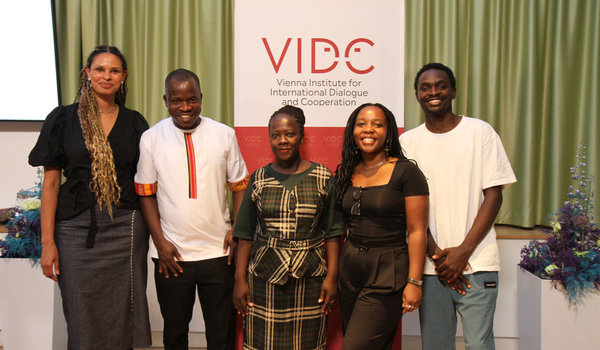
Together with human rights activists, we discussed the impact of European corporations’ business interests on people, the environment and the climate in Uganda; the strategies they have developed in the face of growing autocracy and shrinking civil spaces; the need for transnational solidarity; and the role Austria can play.
Local Impacts: Land Rights, Compensation and Gendered Inequalities
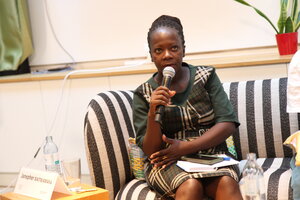
Janepher Baitwamasa of the Navigators of Development Association emphasised that these compensation processes reproduce existing patriarchal structures. Compensation payments were made predominantly to the male heads of households, while women continue to be excluded from land ownership and inheritance in many cases. In response, Baitwamasa’s work focuses on mobilising women’s and youth movements and ensuring their participation in negotiation processes.
Colonial Continuities in “Green” Development Models
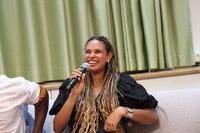
Author and activist Fatim Selina Diaby offered a broader critique of dominant development models. She argued that extractivist and colonial continuities are not limited to fossil fuels but are also reproduced through aspects of the so-called green energy transition.
Shrinking Spaces and Civil Society Responses
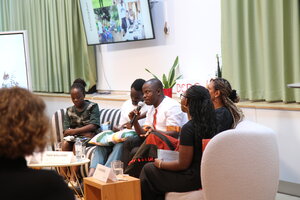
A central theme of the discussion was the increasingly restricted space for civil society in Uganda. Opio, Omonuk and Baitwamasa pointed to the criminalisation of activists and described the creation of a specialised police unit tasked with protecting oil and gas infrastructure, which routinely suppresses protests through arrests and intimidation. Omonuk added that these forms of repression disproportionately affect young people. According to Omonuk, state and corporate influence also extends to public discourse. He described how TotalEnergies exerts influence over local media outlets through sponsorship arrangements, leading journalists to refrain from reporting on human rights violations out of fear for their jobs. Fossil fuel companies were also said to seek influence within universities through the funding of career fairs and scholarship programmes. Omonuk highlighted ongoing civil society efforts to systematically map the connections between fossil fuel corporations and educational institutions in order to expose the industry’s greenwashing strategies.
Political Demands
Looking ahead, the panelists focused on several concrete political demands:
Limiting environmental damage: Immediate implementation of promised environmental and compensation measures in order to reduce biodiversity loss and environmental destruction during the ongoing construction phase.
Labour rights: Increased monitoring of labour conditions among international and local subcontractors involved in the project.
Protecting civic space: Safeguarding community organising, trust and solidarity networks.
Transnational accountability: Stronger legal regulations, such as those discussed within the framework of the European Corporate Sustainability Due Diligence Directive (CSDDD), to hold transnational corporations accountable for human rights violations and environmental damage in production countries.
European civil society responsibility: The speakers called upon European civil society not only to express solidarity through donations but also to actively investigate the involvement of European companies and exert political and legal pressure within Europe itself.
You can explore the event report and learn more about the activities of the research project Fostering International Civil Society Cooperation: The EU CSDDD as a New Entry Point for Just Transition (FICSC-EUCSDDD).