

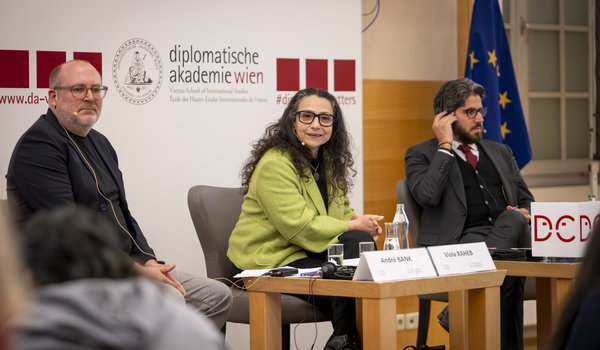
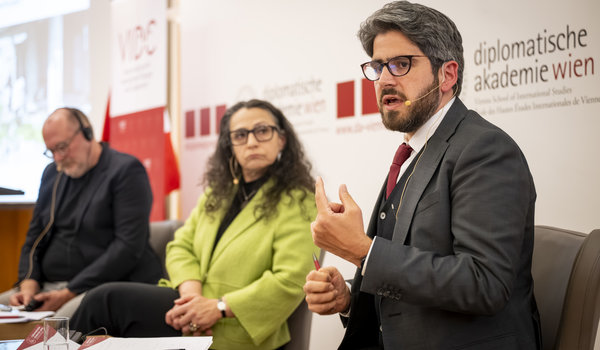
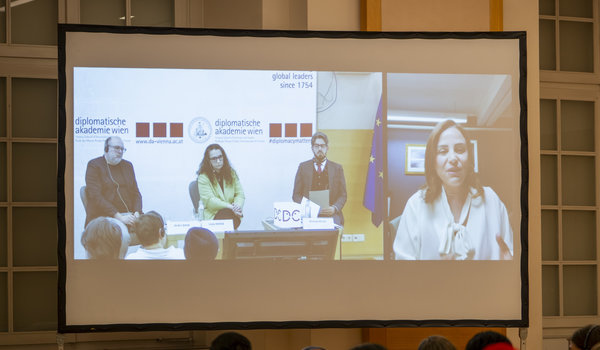
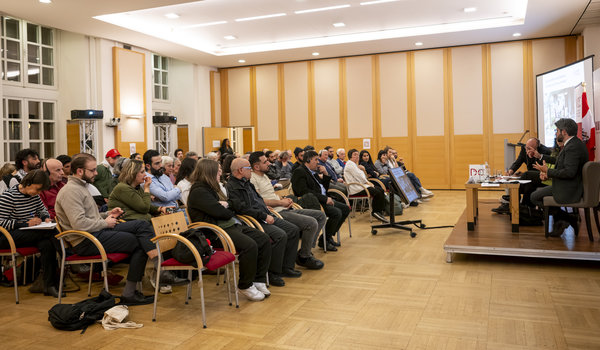
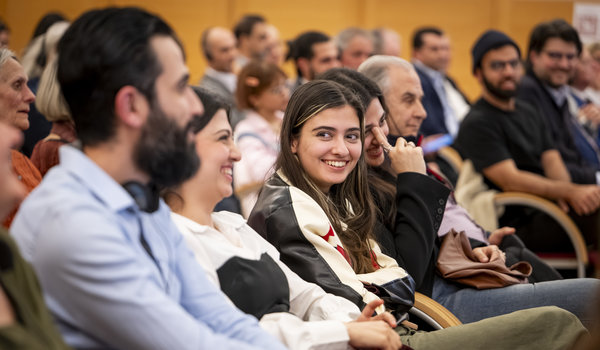
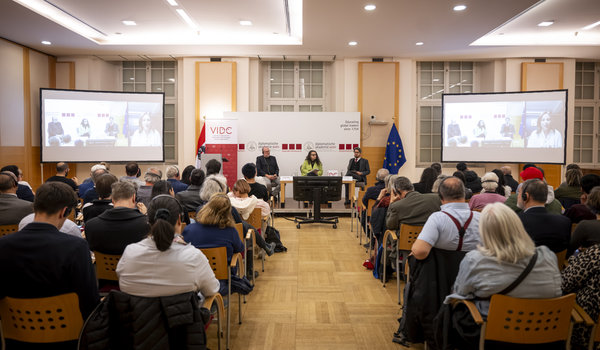
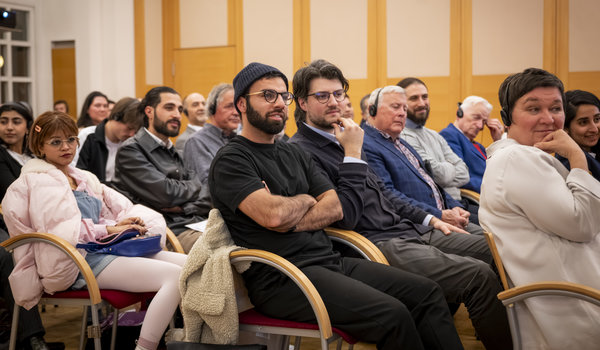
On March 25th, 2026, the VIDC hosted a panel discussion at the Diplomatic Academy in Vienna discussing the political developments that have occurred in Syria since the fall of the Assad regime.
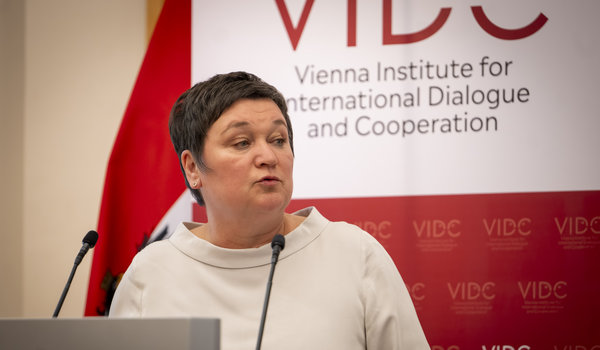
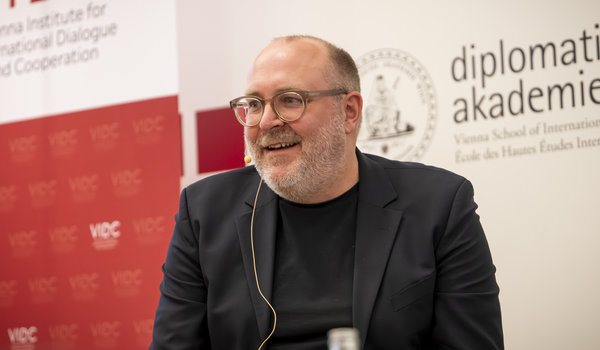
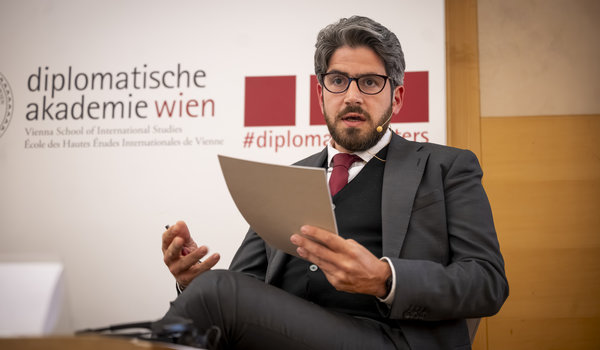
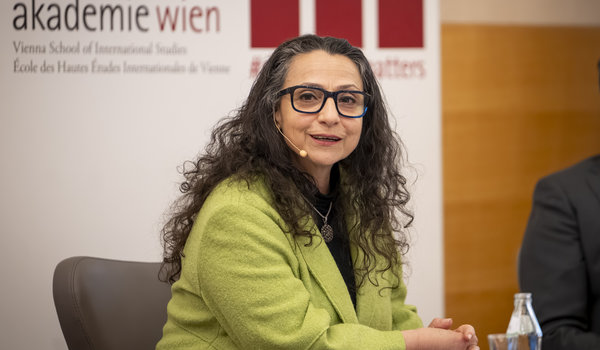
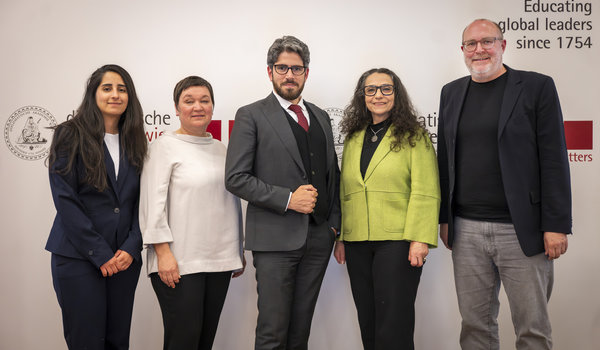
The panel was moderated by Viola Raheb and included contributions from Zozan Alloush, an independent political and humanitarian advisor who specializes in conflict transformation and women's empowerment; Ahmad Helmi, a human rights activist, former political prisoner, and founder of the TA'AFI Initiative; and André Bank, Senior Research Fellow at the GIGA Institute for Middle East Studies.
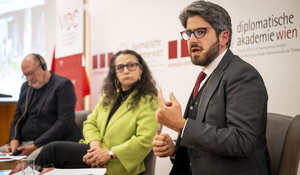
One year after the the dictator’ fall, the question was not only what politically and socially had changed in Syria, but above all whether the country actually has a chance to reinvent itself. The overarching theme of the discussion was to address how we can build a new society that does not rely on authoritarianism and war for its foundation. The Syrian civil war resulted in the complete destruction of the country, through a loss of infrastructure and buildings, but also caused severe and lasting damage to the fabric of Syrian society. For a successful transformation process, political reform willingness, inclusive structures and functioning mechanisms of transitional justice are needed, complemented by responsible international support.
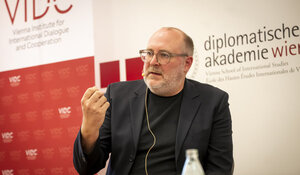
André Bank started the discussion by giving an overview of the most important political developments in the past year since the fall of the Assad regime. The transitional government set a five-year period for a transitional phase with the goal of adopting a permanent constitution and conducting free elections. He briefly summarized several milestones including: the lifting of all international sanctions against Syria; adoption of a new transitional constitutional declaration; indirect election of members of parliament; creation of two separate commissions to deal with issues of transitional justice and missing persons. However, the parliament has not yet been formally established.
At the same time, he pointed to ongoing violence and documented crimes, for example against Alawite and Druze minorities. And emphasized the danger that some minorities might seek an international "protector," which in turn could lead to a renewed outbreak of civil war. Despite these developments, he assessed the situation in historical context as comparatively stable: After more than 50 years of dictatorship and 14 years of internationalized civil war, the current situation appears "not so bad" in light of what could have happened.
The Syrian civil society has never been as alone as it is now since 2011.
With a view to the regional dynamics, however, he warned of new risks. The US-Israeli war against Iran as well as Iranian attacks on the Gulf states could further exacerbate Syria's economic situation - which is still fragile - as potential investors would increasingly hold their financial resources in their own countries.
According to Bank, the question of democratic change depends largely on the political will of the Syrian population, which although has an active and competent civil society, suffers from a lack of international support. "The Syrian civil society has never been as alone as it is now since 2011," he emphasized.
Zozan Alloush highlighted that international support for Syria must not take place unconditionally. European donors should tie their financial aid more strongly to democratic reforms and transparency to promote sustainable developments. At the same time, it is also in the interest of the European Union to contribute to the stabilization of Syria – not least with regard to possible return perspectives for refugees.
Another focus of her contribution was the Kurdish question. Alloush emphasized that in the past year numerous political misdecisions had been made by both sides, the transitional government and Kurdish representatives, which have cost human lives. Lessons must be learned from this to avoid future escalations in other parts of Syria.
She referred to a current agreement between the Syrian Democratic Forces (SDF) and the Syrian government, which provides for the complete integration of the Kurdish-led forces in northeast Syria into the national army. This is generally assessed positively by the involved actors. It could above all mean the end of the division between Kurds and Arabs and the first step for the unification of all of Syria under an inclusive leadership.
There is no lack of competent women, but of their chances to bring in their competencies.
For Alloush, the causes of the previous tensions lie particularly in the lack of political inclusion in the government formation as well as in the delayed recognition of Kurdish rights. However, the concrete implementation and the control mechanisms remain open, especially the question of how female Kurdish fighters can be integrated into the central state structures. According to Alloush, the goal must be to rebuild a decentralized Syria that enables equal participation for all its citizens.
Alloush emphasized that the inclusion of women in political leadership and the army will never happen by itself; for that, a clear will of the political leadership is needed. "There is no lack of competent women, but of their chances to bring in their competencies." This applies both to political leadership and to administration.
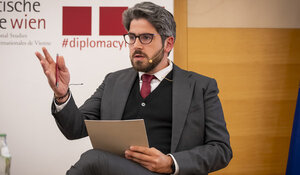
Ahmad Helmi emphasized the importance of coming to terms with the massive violence and traumas that have shaped Syrian society for decades. Sustainable reconciliation can only succeed if these experiences are comprehensively acknowledged and processed. A prerequisite for this is an inclusive, victim-centered policy that ranges from the acknowledgment of the crimes to apologies to possible criminal proceedings. He recognizes the government's interest in this, but transparency and mechanisms for transitional justice are lacking.
At the same time, he showed himself realistic regarding the limits of legal proceedings: It is unlikely that all perpetrators can be held accountable. Nevertheless, this circumstance must not lead to resignation. Rather, there is a need for a new legal basis for transitional justice, which can serve as the first serious test for the credibility of the government.
This takes away our right to obtain justice through legal means.
Helmi warned against vigilante justice and revenge in Syrian society "Whoever executes perpetrators without trial commits not only a crime against this person, but also against “us” his victims. This takes away our right to obtain justice through legal means."
Without functioning mechanisms of transitional justice, there is a danger that affected victims will try to enforce their "rights" independently – which could trigger new spirals of violence. Helmi emphasized the importance of political accountability from the Syrian population towards the new government, because even a good person can become a dictator if control and accountability mechanisms are absent.
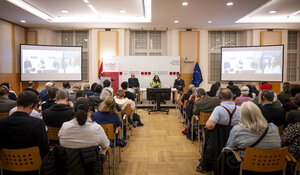
In the final round, the panelists emphasized the ongoing need to keep Syria present in the political and societal discourse despite global crises and declining international support services. Especially at a time when development and aid funds are decreasing worldwide, the country must not fall out of focus.
At the same time, they formulated a deliberately sober outlook for the coming years. With cautious optimism, it was noted that a comprehensive democratization of Syria is not to be expected in the next four years. Above all, because international actors hardly want to see that in Syria. After all, dealing with a strong and authoritarian leadership is simpler. Realistic goals should therefore be in the foreground: preventing a renewed outbreak of civil war, limiting the influence of external actors with partly opposing interests – especially Israel and Turkey – and ensuring that no new presidential dictatorship solidifies in the course of the transition phase.
A Peace initiative
In conclusion, a civil society project of the organization Equity and Empowerment was presented as an example of concrete peace work in Syria. The initiative aims to build social bridges by enabling encounters between different communities – for example through joint trips to different cities, cultural exchange, joint concerts as well as workshops on peace work and conflict resolution.
Such projects make an important contribution to promoting dialogue and social cohesion. At the same time, they are highly dependent on international support and financial resources.