





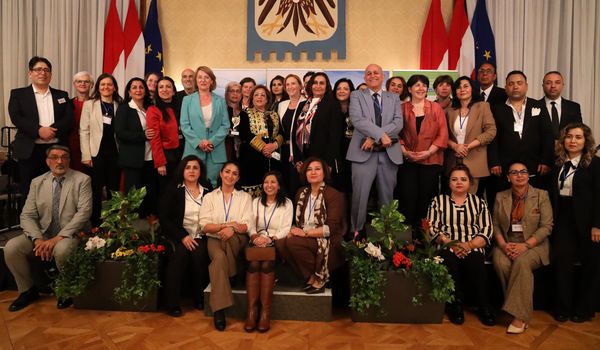
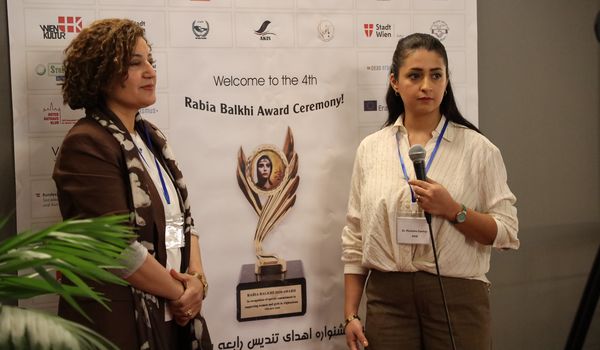
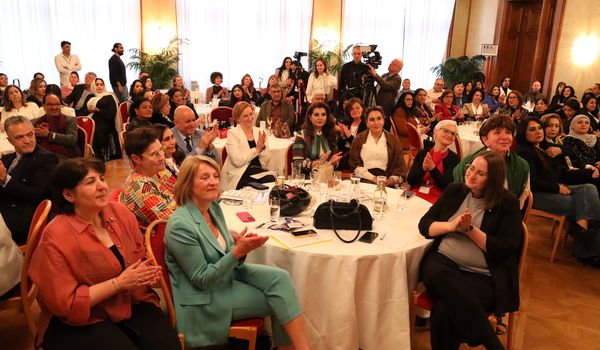
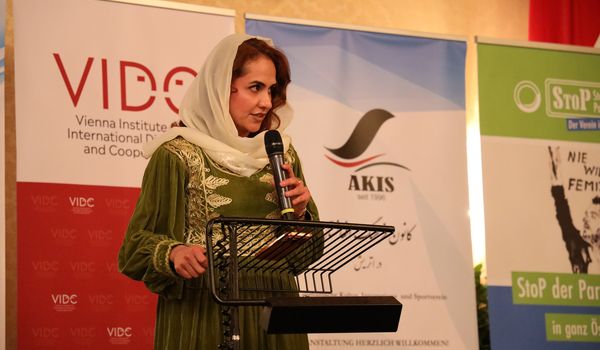
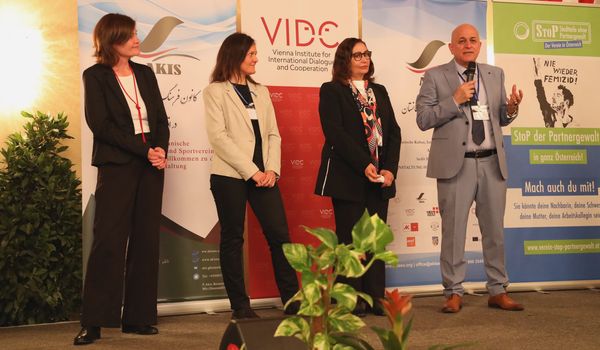
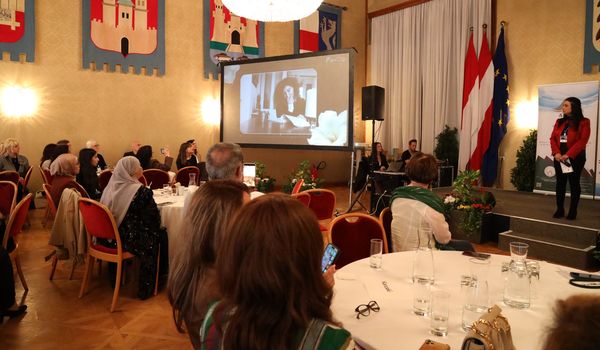
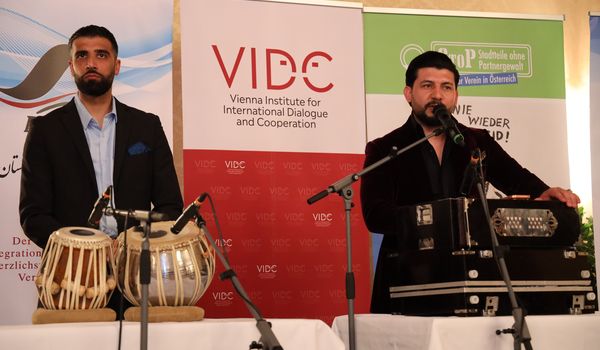
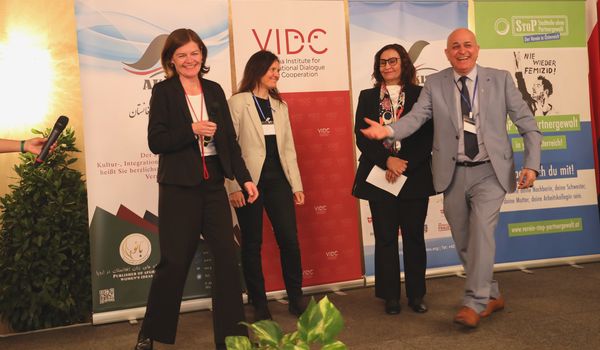
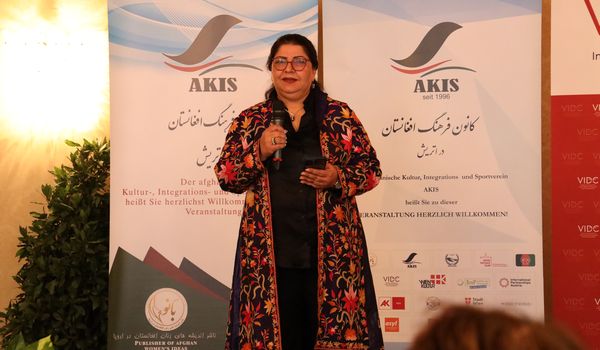
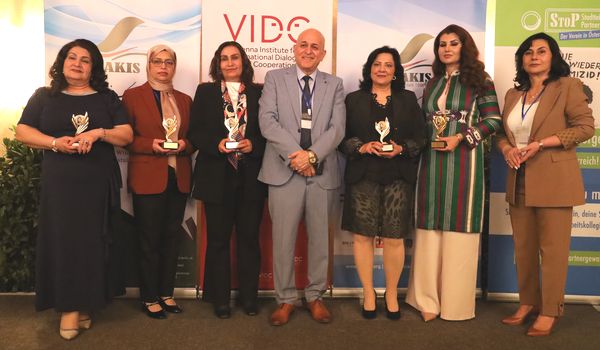
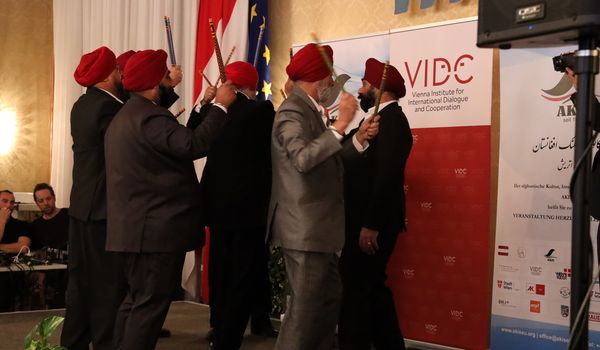
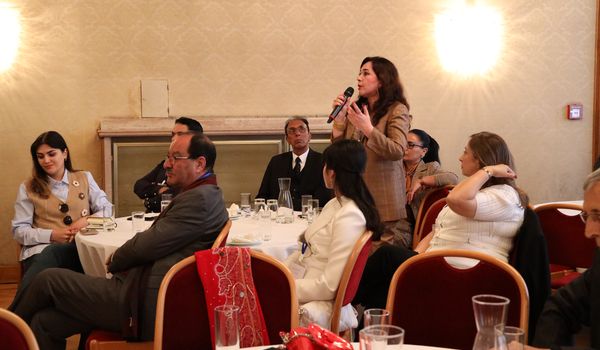
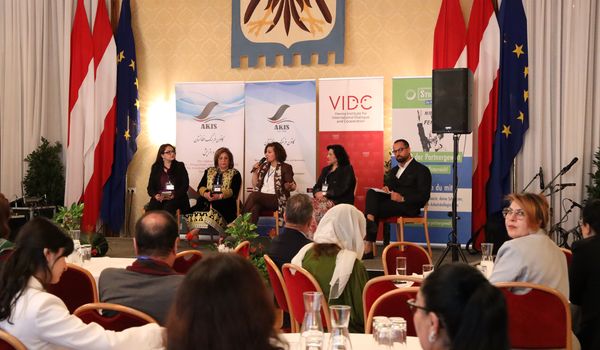
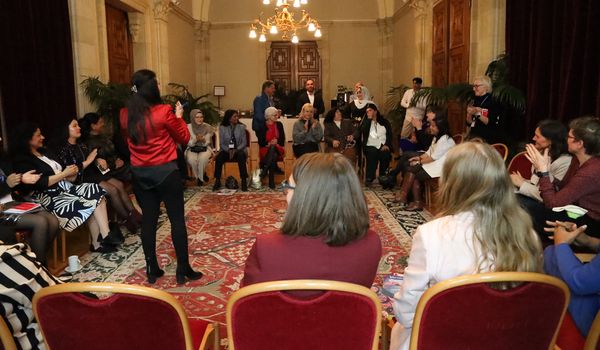
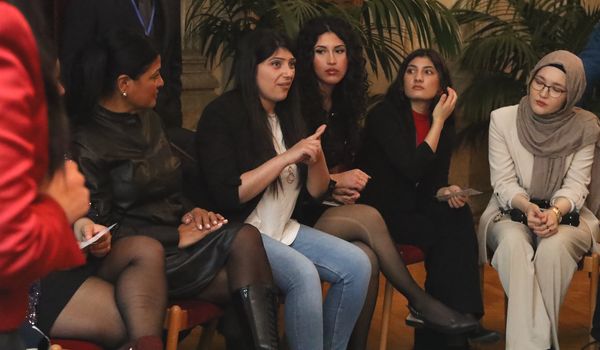
To mark the 30th anniversary of the Afghan Cultural, Integration, and Sports Association AKIS and the 26th anniversary of Banu Women’s Magazine, the association organized a conference with an evening reception on April 10, 2026—in cooperation with the VIDC and the Vienna Chamber of Labor (Department for Women and Gender Equality Policy). The event began with a half-day conference and culminated in a festive reception in the Wappensaal of the Vienna City Hall. Around 200 guests from eight European countries, including primarily women from the Afghan diaspora as well as representatives of Austrian politics, attended the event.
Political Support from Austria and the European Parliament
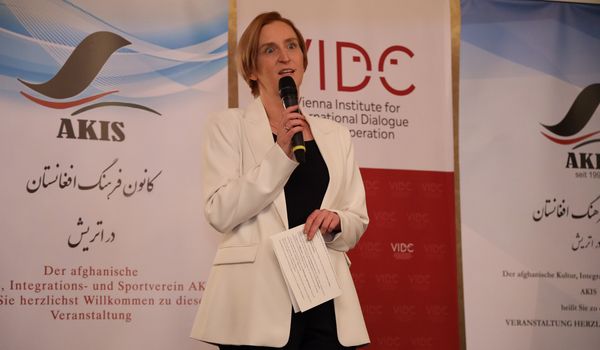
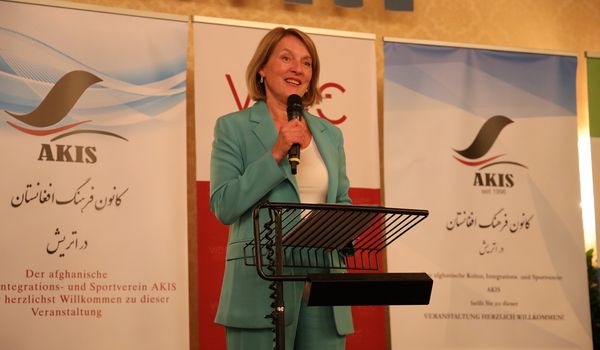
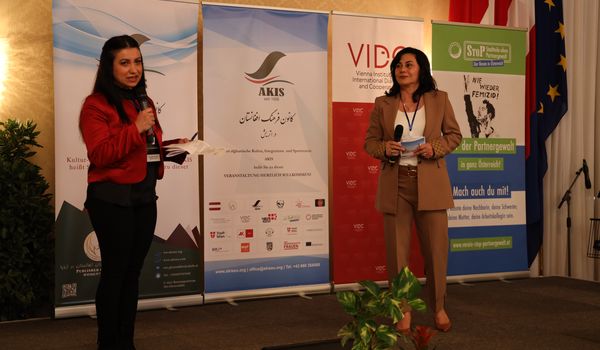
Moderated by Gawhar Musleh, a board member of AKIS, and Michael Fanizadeh from the VIDC, the evening reception was opened by Vienna’s new City Councilor for Women’s Affairs, Elke Hanel-Torsch. She thanked the AKIS association for its commitment, courage, humanity, and solidarity. Hanel-Torsch emphasized that the association makes a tremendous contribution to the cultural sector through its work—particularly through its efforts with young men, who are trained as part of the association’s activities to prevent radicalization.
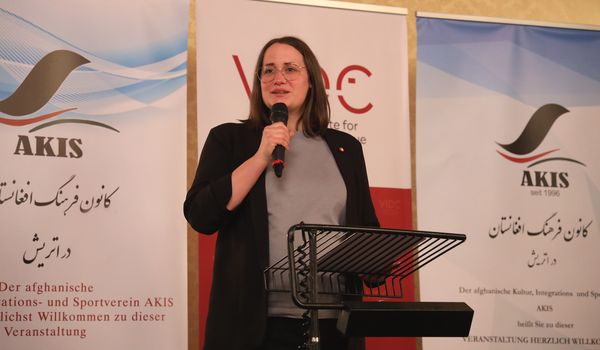
The opening speech was followed by a greeting from Austria’s Federal Minister for Women, Eva-Maria Holzleitner, who expressed her solidarity with women and girls in Afghanistan: “That is why it is right and important to advance the international discussion on recognizing gender apartheid as a crime against humanity. (…) It is our shared responsibility to amplify the voices of women in Afghanistan, to empower them, and to support them in their struggle for freedom and self-determination.”
In her speech, MEP Evelyn Regner emphasized that the situation of women and girls in Afghanistan since the Taliban took power in 2021 represents one of the most serious human rights crises of our time. Systematic oppression has made women’s lives unbearable. Regner cited over 100 Taliban decrees that exclude women from public life, describing this as gender apartheid, a structural system of exclusion. She highlighted the role of the European Parliament, which has been exerting pressure since 2021 through resolutions—such as condemning the ban on girls’ education or calling for the release of detained activists. A milestone, she noted, was the ruling by the European Court of Justice recognizing discriminatory measures against Afghan women as persecution under the Geneva Convention on Refugees. This facilitates the protection of women within the European asylum system. Regner underscored the importance of international solidarity: The EU must exert its influence on regional actors such as Qatar or Pakistan, engage the Afghan diaspora, and maintain political and economic pressure. “We must not look away,” she urged. Collaboration between different groups – as seen at the event in Vienna – is crucial to amplifying the voices of Afghan women. She concluded by assuring them: “We stand by your side.”
Afghan Women Against Gender Apartheid
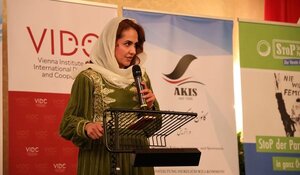
In her remarks, Nargis Mommand Hassanzai, a former professor at Kabul University who now lives and works in Germany, emphasized the responsibility to participate in the event in solidarity with the women of Afghanistan and in support of their right to education. The evening was not only dedicated to the anniversaries of AKIS and the women’s magazine Banu, but above all to the fight against the systematic disenfranchisement of Afghan women—a reality she described as gender apartheid. It is particularly painful, she noted, that in the 21st century, a country like Afghanistan continues to deny education to half of its girls. Education is a fundamental right, yet for Afghan girls it seems like an unattainable dream. Despite all the challenges, the girls and women would not remain silent—both at home and in the diaspora, thousands of voices are rising, supported by the international community, to fight for education and fundamental rights. Hassanzai called for Afghanistan to be viewed as a whole: women’s rights, science, and society are inextricably linked. While conferences and resolutions are important, concrete action is now needed. The event should serve as a call to action: “We must translate words into action.”
The Afghan Ambassador to Austria, Manizha Bakhtari, also emphasized the commitment and courage of the women and girls in Afghanistan, who, despite all challenges, would not remain silent and were standing up against systematic discrimination. She noted that thousands of voices are uniting both within Afghanistan and in the diaspora, including those of the international community. These voices are speaking out for rights, education, and fundamental human rights.
VIDC and AK Vienna support the fight against gender apartheid and for successful integration
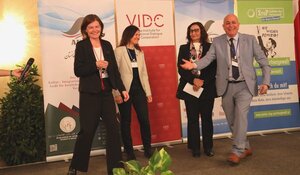
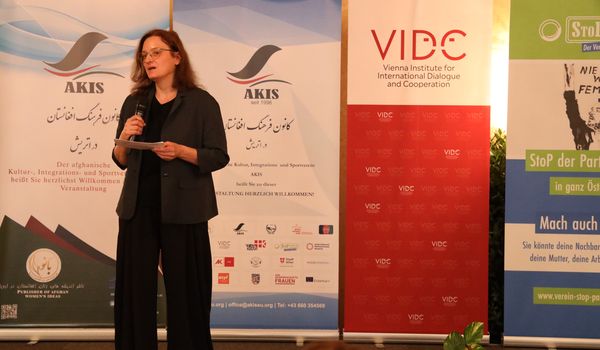
Sybille Straubinger, Director of VIDC, and Vera Glassner from the Vienna Chamber of Labor, as cooperation partners of AKIS, reaffirmed their commitment to the fight against the systematic oppression of women and girls in Afghanistan and for successful integration into Austrian society. Straubinger emphasized that, given the many global crises, there is a danger that the ongoing situation in Afghanistan will be forgotten. While the world often focuses only on the current crisis, Afghanistan remains a catastrophic reality for the people on the ground, especially for women. To ensure this issue does not lose focus, the VIDC, together with other initiatives, drafted a letter to all 183 members of the Austrian Parliament, calling for gender apartheid to be recognized as a crime against humanity and enshrined in international law.
Vera Glassner recalled the long-standing collaboration with AKIS and the VIDC. The annual conference is a highlight of this cooperation, in which the Chamber of Labor participated again this year with a workshop—featuring, among others, impressive Afghan women, representatives of the AMS, the ÖGB, and various associations and NGOs such as the Counseling Center for Migrants. The event symbolizes the shared commitment to keeping the situation of Afghan women in the public eye and providing concrete support. She also extended her thanks to her recently deceased colleague at the Vienna Chamber of Labor, Asiye Sel, who coordinated the partnership with AKIS for many years.
30 Years of AKIS
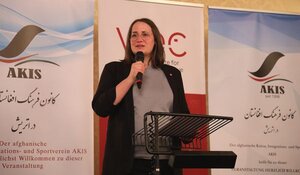
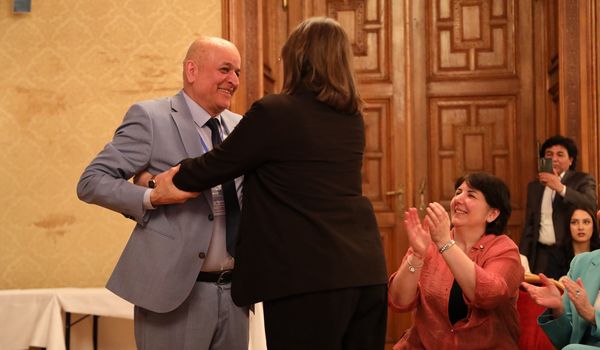
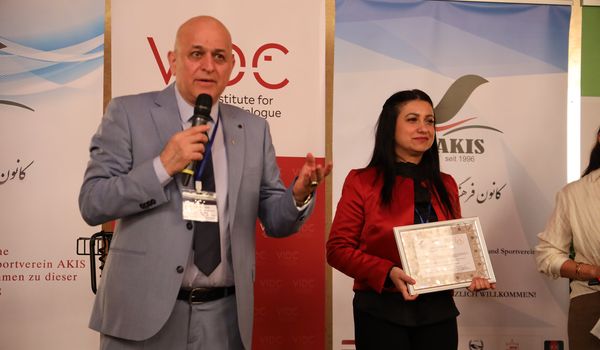
AKIS Chairman and founder Ghousuddin Mir thanked the supporting partners and the City of Vienna for their long-standing support and once again acknowledged the tremendous support provided by Asiye Sel of AK Vienna: “We miss her very much, but we will cherish her memory.”
City Councilor Marina Hanke delivered the laudatory speech marking AKIS’s 30th anniversary. In her speech, Hanke highlighted the special symbolic significance of Vienna City Hall: As a place of decision-making and solidarity, it stands for a city that embraces diversity and gives a voice to diaspora communities such as the Afghan one. But the evening was dedicated above all to AKIS—an organization that, since 1996, has become not just an institution but a lifeline for thousands of people. AKIS has evolved from a small initiative into a key player, supported by partners such as the City of Vienna, Caritas, ÖGB, and the Chamber of Labor. For over 30 years, the organization has provided concrete assistance—ranging from asylum counseling and violence prevention to educational projects that have reached 80,000 girls in Kabul. Particular mention should be made of the volunteer commitment of the many people who support AKIS with their time, energy, and conviction. The association’s work embodies a deeply rooted conviction: education as a human right, community as a source of strength, and solidarity as a bridge between Vienna and Kabul. AKIS proves that civil society can overcome borders and change lives—an achievement that is celebrated today and offers hope for the future.
Resolution and Commitment of AKIS’s Young Generation
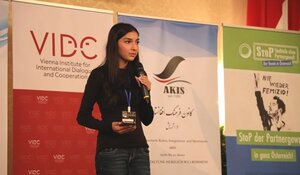
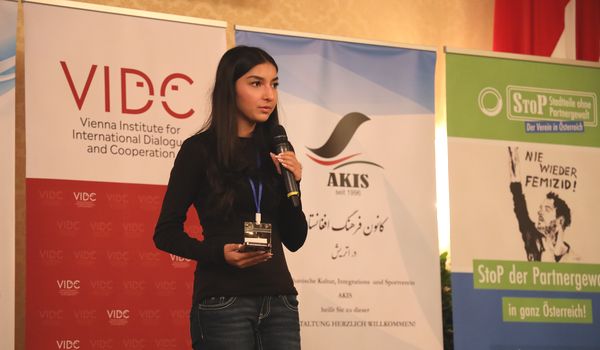
During the conference, a resolution was also read aloud, and input was provided by AKIS representatives Hosana Nadiri, Hadia Tahiri, Narges Khawari, and Muhadesch Khaledgi. The speakers emphasized the responsibility of the diaspora and pointed out that, as young Afghan women in Europe, they enjoy privileges—such as education, self-determination, and opportunities—that are out of reach for many girls in Afghanistan. They told the story of Nooria, who had to dress as a boy to be allowed to work, and who thus symbolizes millions of women denied their rights and dignity. Thanks to AKIS, however, they have a platform as women to be heard, and they feel compelled not to remain silent. The young generation of AKIS sees it as their mission to fight on behalf of Afghan girls and to show what is possible when opportunities are given. They emphasized: Education is not a privilege, but a fundamental right, and as long as girls in Afghanistan are excluded from it, the world must not look away. Their appeal was to be a voice for those who have none—because freedom and dignity are indivisible.
Forozan Wakili, a student, described in her speech the deep pain that fills her. She explained that her heart is heavy when she thinks of her female classmates in Afghanistan, who are denied further schooling after 6th grade. These girls dream of becoming diplomats, doctors, or politicians and helping to shape their country’s future. Instead, however, they are trapped in their homes, living in fear, and forced to accept a fate as wives of the Taliban and mullahs. Wakili expressed the fear that even a possible reopening of schools by the Taliban would not bring genuine education—instead, there is a threat of indoctrination with extremism and violence, rather than modern science and technology.