

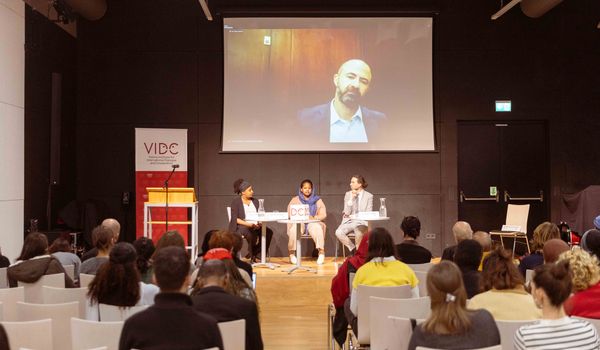

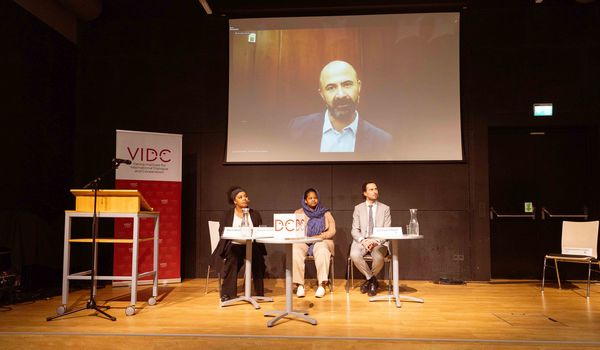
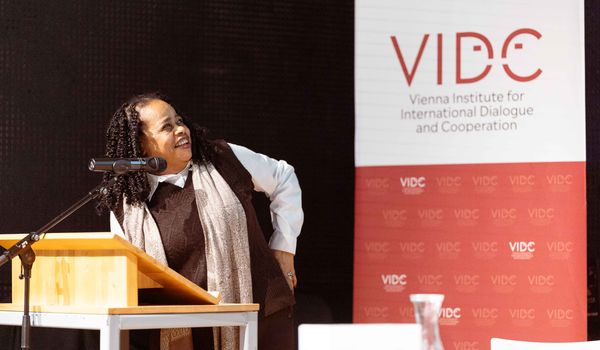
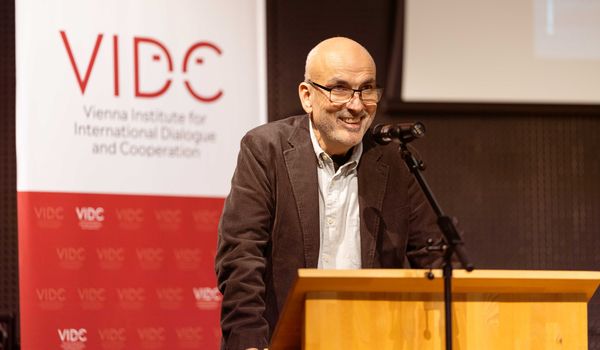
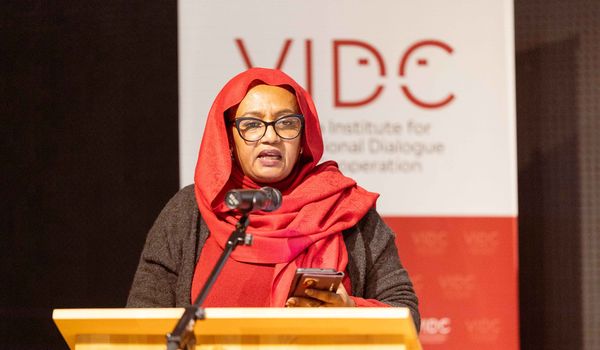
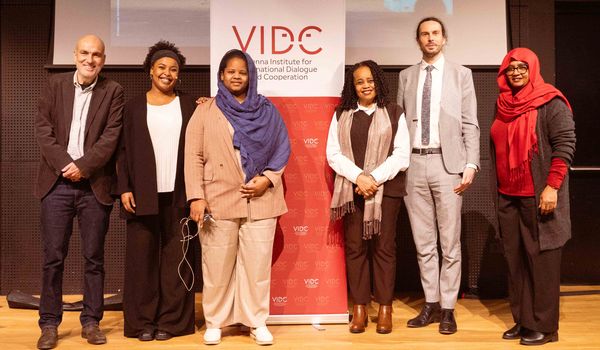

Die Veranstaltung am 10. Dezember 2025 in Wien vereinte Expertinnen für Migration und Menschenrechte, Aktivistinnen sowie institutionelle Vertreter*innen, um über die humanitäre Krise im Sudan und den seit April 2023 andauernden Konflikt zu diskutieren.
Der Bericht zur Veranstaltung liegt leider nur in englischer Sprache vor.
Summary report by Isabella Costa
The event on 10 December 2025 in Vienna brought together Migration and Human Rights experts, institutional representatives, local voices and grassroots organizations to talk about the humanitarian crisis in Sudan and the current conflict that erupted in April 2023. The aim was to bring different perspectives, lived experiences and data to raise awareness about the real situation of Sudanese people, displacement, and the funding challenges for the work of NGOs and International Organizations. Beyond highlighting how the conflict has affected the region and resulted in serious human rights violations, speakers also emphasized the active role of the Sudanese diaspora in supporting and providing assistance to affected communities. In this sense, the panel also served as an act of solidarity, seeking to increase visibility around the situation in Sudan and to contribute to discussions on justice and peacebuilding.
Widespread violence against civilians and the funding challenges to humanitarian action
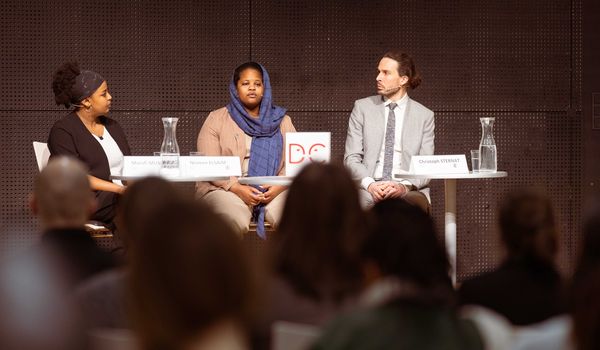
The panel discussion, led by Marafi Mustafa, opened with a statement by Mohamed Refaat, Chief of Mission for the International Organization for Migration (IOM) in Sudan. An Egyptian national, Refaat has expertise in early recovery, resilience in post-conflict humanitarian settings, and displacement emergency responses. He provided updates of the current humanitarian situation in Sudan and shared insights into the challenges of operating on the ground protecting refugees. Refaat emphasized that Sudan currently has approximately 9.6 million internally displaced people (IDPs) as a result of the conflict.
While this number represents a decrease from the 11.9 million IDPs recorded earlier this year, he cautioned against interpreting this as a sign of improvement. Atrocities and violence against civilians – particularly conflict-related sexual violence against women – remain widespread and occur on a daily basis. Although Sudan briefly gained bigger attention in mainstream media following the events in El-Fasher in October, Refaat emphasized that such violence is not exceptional, but rather reflects the routine reality experienced by Sudanese communities week after week and month after month. Women and children have been disproportionately affected, both by violence and by forced displacement.
He stressed the urgent need for accountability, justice, and prevention to ensure that such violations do not happen again. While humanitarian action, protection of responses, and basic infrastructure remain essential to protect civilians from violence, hunger, and health crises, Refaat underscored the severe constraints faced by humanitarian actors. In face of the funding cuts, he stated that “we would not just close our office; we would not just stay away […] at one point I had to let go of 73% of my staff in the office.”
These cuts have affected not only protection activities but also the livelihoods of families who were depending on humanitarian employment. Those cuts impact not only the protection activities, but also the life of families who were depending on these jobs. The situation is so hard that Refaat tells us that at some point, with the lack of resources, they need to choose which shelter for victims of sexual violence to continue supporting, which refugee shelter they will keep maintaining, and which one would need to be closed. In his speech, it was very clear how hard it is to work with these cuts and choosing who to support and who just left unsupported, because these are people’s, children’s lives. Consequently, this implies a constant negotiation of how to continue and how to choose priorities. As a last remark, Refaat emphasizes the need for a ceasefire and the hope of establishing a peace agreement. Beyond breaking the silence, it is also necessary to stop the flow of armament to the conflict and keep bringing resources to Sudan and to humanitarian efforts.
"Human lives aren’t just numbers”
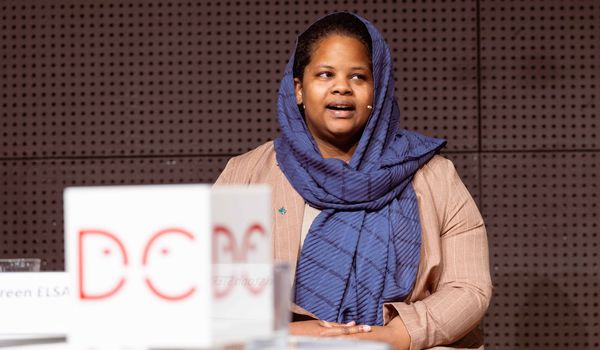
Our second speaker was Nisreen Elsaim, a Sudanese environmental, climate, and Human Rights activist, who brought her lived experience as a person who fled from Khartoum, as well as data from her work on Sudan’s conflict and displacement. She began her remarks by emphasizing the basics: every human being has the right to dignity, regardless of color, religion, or nationality. This should be guaranteed to everyone in the world. However, this is not the reality for Sudanese people in the current context. But why is Sudan not in the news, or rather, in mainstream media?
Elsaim addressed this question with two key points. First, for a long time, the media has portrayed Sudan, and other African countries, with a colonial image of barbarity, as if everyone were constantly killing each other. This narrative normalizes the problems in these countries, ignoring that Sudan is much more than this, it has culture, nature, and life beyond war – things most people do not know about it. Second, external interference in Sudan has always served external interests rather than the Sudanese people themselves. Consequently, peace agreements were developed far from the communities they affect, which is why they never work.
Elsaim shared findings from a 2018 study she conducted with young people aged 18 to 30, in which 84% stated they would cross the Mediterranean to Europe, even with a 90% chance of not surviving. This highlights that, even before the current conflict, and amid an already critical situation under the previous government, many were willing to risk their lives for the small chance of survival. She emphasized that these numbers represent a real lack of hope and the depth of despair among the population. According to Elsaim, if states do not want migration, they should invest in local communities, building resilience, strengthening governance, and creating opportunities. She argued that securitization and militarization do not prevent the problem, they fuel it. Elsaim also highlighted that the Khartoum Process, promoted by the European Union to prevent migration, actually provided resources to the RSF, who are now actively fighting in Sudan.
Furthermore, she discussed the changing aspirations of young Sudanese. After the 2019 revolution, only 20% wanted to migrate to Europe through the Mediterranean, showing hope for basic services such as health, education, and food. However, a later survey of 2,000 young people, conducted three months after the war started in 2023, revealed that 92% prioritized education above immediate survival needs, seeing it as the only way to move forward. Peace was also widely desired, but social media and misinformation have fueled the ongoing conflict. Hate speech and disinformation by both the RSF and armed forces have escalated violence, which was exemplified by a July 2024 incident, where people were killed in a livestreamed “marathon of slaughter”. Following that, she criticized global responses that focus on crises rather than prevention, highlighting the need for aid to avoid creating dependency and to support long-term solutions. Finally, she emphasized the compounding effects of conflict and climate change, noting that the 2024 floods displaced 2 million people, perpetuating cycles of insecurity and forced movement, and illustrating the need for holistic solutions. Elsaim concluded by stressing that behind every statistic are real lives, families, and communities: “these numbers are us,” she said.
The conflict in Sudan should be treated as a regional issue, rather than a local crisis
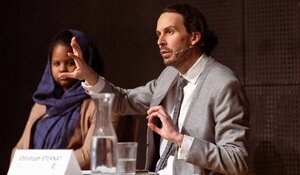
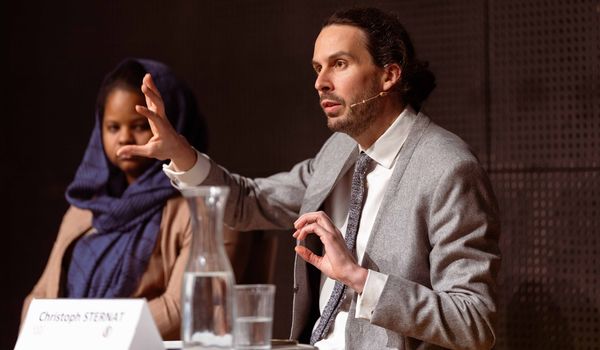
Our last speaker from the first part of the panel was Christoph Sternat, from the Austrian Foreign Ministry in the unit of Humanitarian aid and Food aid. His remarks outlined how Austria structures its humanitarian assistance, mainly through the Foreign Disaster Fund, which also had a budget cut this year of €30 million, and through Austrian Development Agency (ADA) budget lines. Austria prioritizes crises across an arc surrounding Europe, the Middle East, and Sudan. The aid strategies are based on the Austrian 2023 Humanitarian Strategy, which emphasizes linking humanitarian aid with development and peacebuilding, localization, and innovation. Sternat brought up some aspects of Sudan’s conflict, highlighting that the conflict has produced the world’s largest displacement crisis, mass killings, ethnically targeted violence, torture, especially after the RSF takeover of El-Fasher.
Sudan also faces the world’s largest food security crisis, with 21 million people in food insecurity. Moreover, 80% of health facilities in the country are non-functional. Humanitarian access remains severely restricted, what impacts not only Sudan, but the whole region. He stressed that Sudan cannot be addressed without considering the broader context. Neighboring countries such as Egypt and Chad host large numbers of refugees despite facing their own social and economic pressures. The regional dimension of the crisis means that assistance must be designed with cross-border dynamics in mind rather than focusing solely on Sudan itself. Sternat also underlined the role of the European Union and its Member States.
The EU has designated Sudan as a priority crisis and has maintained a consistent diplomatic effort to push for the protection of civilians and unhindered humanitarian access. Several Member States have issued letters and coordinated political messages over the past two years to keep Sudan on the international agenda and to reinforce demands for compliance with international humanitarian law. Since the beginning of the conflict in April 2023, Austria has provided more than €40 million in humanitarian assistance to Sudan and neighboring countries. Austria also collaborates with partners such as IOM, the Red Cross, UN agencies, and other NGOs. Christoph Sternat concluded by reaffirming Austria’s commitment to a coordinated international response, guided by humanitarian principles and focused on protecting civilians in Sudan and throughout the region.
Sudanese resilience and solidarity as a tool for survival
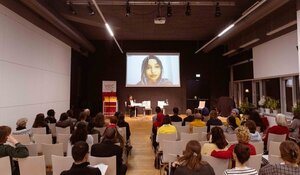
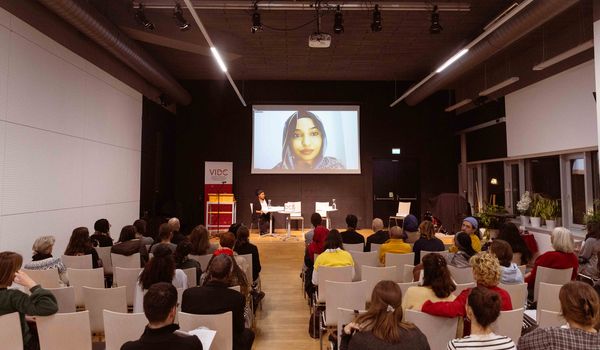
The second part of our panel focused on remarks by two Sudanese Youth, Yassin Mohammed Alsamany and Omniya Anwer Khalid Ahmed, that underscored the resilience and agency of Sudanese in the context of the ongoing conflict and mass displacement. Omniya Ahmed emphasized that, despite the collapse of state institutions, communities in Sudan have built their own support systems through local solidarity networks, including women’s groups, neighborhood initiatives, and youth-led actions that provide food, shelter, basic healthcare, and emotional support. She highlighted the determination of young people to continue learning and acquire new digital skills, as well as the crucial role of the diaspora in accessing scholarships, remote work, and global networks that help sustain families and transfer knowledge. For her, Sudanese youth are not waiting for change but actively shaping it through community action, continuous learning, and small-scale economic initiatives that restore dignity and a sense of future.
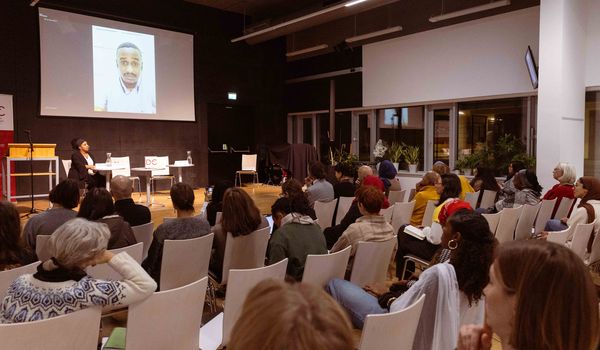
Speaking from Cairo, Yassin Alsamany described the difficult situation faced by Sudanese refugees in Egypt, including economic insecurity, limited access to healthcare and education, legal uncertainties, and the psychosocial impact of trauma and loss. Nonetheless, he stressed that the diaspora community remains active and committed to rebuilding their lives. He pointed to vocational training programmes that equip young Sudanese with valuable work skills and allow them to support their families. He also mentioned community centers that offer safe spaces for learning, social support, and cultural expression. Both speakers highlighted the importance of international support, especially in expanding vocational training, improving access to services through partnerships with local organizations and ensuring emotional and moral support that amplifies Sudanese voices and reinforces a sense of hope.
As a last speaker, Ishraga Mustafa presented the grassroot work of Mendy for Peace, Culture and Diversity Management with Sudanese women and youth in Sudan, Egypt, and Europe. Mendy uses culture, writing, education, and community initiatives as tools for healing, empowerment and memory preservation. Their key activities include writing workshops that enable displaced women to document their lived experiences, storytelling projects, vocational training for displaced Sudanese youth – particularly in Cairo – and educational and cultural programs implemented simultaneously across Sudan, Egypt, and Austria. They also have published books with the stories of Sudanese, as a way to give voice for their lived experiences and resilience.
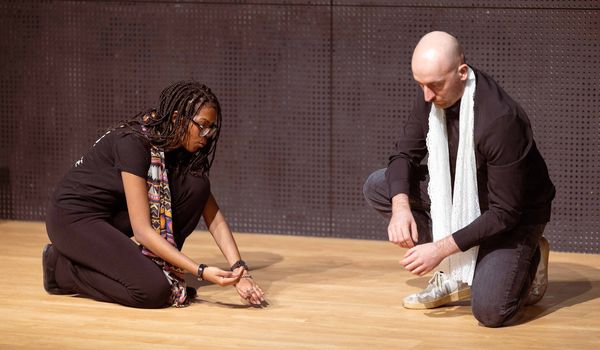
The event also counted with a short performance about Sudan by the Theatre of the Oppressed and a Q&A session. The Q&A discussion addressed key challenges in the Sudanese conflict and the role of international actors. The session emphasized the repeated failures of ceasefires, which are often used by armed groups to regroup rather than advance peace, and the mistrust in the international justice system due to its perceived ineffectiveness. Questions were raised about the involvement of mediators, including the United States, Qatar, and the African Union. The speakers pointed out that many of these counties have veiled interests that compromise neutrality, and that civil society and youth voices remain largely excluded from peace processes. Consequently, there is a need of mobilization of the international community to build a platform that allow Sudanese to come together and discuss strategies and possible solutions for the conflict. Additionally, the interconnection of global conflicts was brought it, as the Sudanese war can be linked with fueling resource flows, such as gold, that impact other crises like the war in Ukraine. As a conclusion, it was highlighted that peacebuilding strategies for the Sudanese conflict requires coordinated pressure on both internal and external actors, prioritizing the protection of civilians and creating conditions for a concrete transition.